
If you win money from gambling in the UK, the winnings themselves are generally tax-free for you as an individual.
You do not normally pay Income Tax or Capital Gains Tax simply because you won money from sports betting, casino games, poker, bingo or the National Lottery.
The Gambling Commission confirmed the position again in May 2026, stating that UK customer gambling winnings are tax-free regardless of the amount won.
Instead of taxing individual players, the UK mainly collects gambling taxes from operators through duties charged on their gambling businesses.
The important distinction is what happens after you receive the money.
Interest earned by putting a large win into a savings account can become taxable, investment gains can attract Capital Gains Tax, and giving money away can create future Inheritance Tax considerations.
So, a £50 football bet win and a £5 million jackpot may both arrive without a personal gambling tax bill, but what happens to the money afterwards can have very different tax consequences.
Do You Pay Tax on Gambling Winnings in the UK?
For an individual player, the straightforward answer is no.
The tax treatment does not normally change simply because:
- The win is very large.
- Gambling is something you do regularly.
- You play online rather than in a physical venue.
- You win from sports rather than casino games.
- You play poker regularly.
- Gambling provides much or all of your living expenses.
The Taxation of Chargeable Gains Act 1992 expressly states that winnings from betting, pool betting, lotteries and games with prizes are not chargeable gains for Capital Gains Tax purposes.
The UK Rule at a Glance
| Type of gambling win | Tax on the original winnings for a UK individual |
| Sports betting | Normally £0 |
| Online casino | Normally £0 |
| Land-based casino | Normally £0 |
| Poker | Normally £0 |
| Bingo | Normally £0 |
| National Lottery | £0 |
| Scratchcards | Normally £0 |
| Large jackpot | Normally £0 |
The amount of the prize does not introduce a separate UK winnings-tax threshold.
A substantial amount of money can still attract additional verification before it is released or transferred. That is a payment, identity or anti-money-laundering issue, not evidence that HMRC is taxing the win.
The difference is worth remembering when checking casino withdrawal and verification conditions: operator cash-out rules and UK taxation are separate questions.
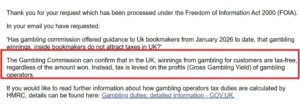
Official UK confirmation that gambling winnings for customers are tax-free regardless of the amount won.
Do You Need to Declare Gambling Winnings to HMRC?
Ordinary gambling winnings do not normally need to be entered on a Self Assessment return merely because you won them.
HMRC’s own Income Tax guidance specifically identifies National Lottery wins among amounts on which individuals do not pay Income Tax.
There is also no special declaration threshold where, for example, winning £1,000 is ignored but winning £100,000 suddenly becomes taxable.
However, retaining evidence of a large legitimate win is sensible.
For a significant payout, consider keeping:
- The operator statement
- Betting account history
- Winning ticket where relevant
- Withdrawal confirmation
- Bank statement showing the payment
- Tournament result or prize confirmation
- Relevant correspondence from the operator
This does not mean you are declaring the winnings as taxable income. It simply creates a clear record of where a large deposit came from if a bank, financial institution or other party later asks for source-of-funds evidence.
Do Professional Gamblers Pay Tax on Their Winnings?
Simply gambling frequently or successfully does not normally turn an individual’s gambling activity into a taxable trade.
HMRC’s Business Income Manual states that having a betting system or being successful enough to earn a living from gambling does not itself make the activity a trade.
That principle was reinforced again in a March 2026 High Court judgment, which reviewed the longstanding tax authorities and said that gambling alone does not become self-employment merely because the person is sophisticated, organised or successful.
Someone earning substantial professional poker winnings therefore does not automatically become liable to Income Tax on those winnings simply because poker is played seriously or repeatedly.
Professional Gambling Versus Related Income
The distinction becomes important when a successful gambler earns money around the gambling activity.
| Income | Likely tax position |
| Poker prize winnings | Normally tax-free |
| Sports betting winnings | Normally tax-free |
| Casino winnings | Normally tax-free |
| Sponsorship fee | Potentially taxable |
| Paid appearance | Potentially taxable |
| Advertising income | Potentially taxable |
| YouTube or streaming income | Potentially taxable |
| Affiliate commission | Potentially taxable |
| Coaching income | Potentially taxable |
In other words, the bet or game may be tax-free while a commercial business built around the person’s reputation or audience can create normal taxable income.
Tax accountant Noman Abbasi ACCA summarises the underlying distinction simply:
“gambling winnings are not taxed.”
His wider analysis also notes that separate income generated around gambling can create different tax consequences.
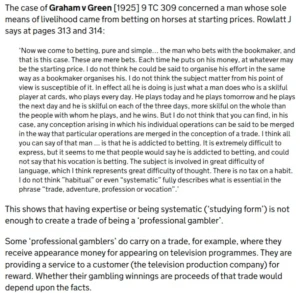
HMRC guidance explaining why successful or systematic gambling does not automatically constitute a trade.
Can You Claim Gambling Losses Against Your UK Tax Bill?
Normally, no.
The favourable side of the UK system is that ordinary gambling winnings are not taxed. The corresponding downside is that gambling losses do not generally become deductible expenses that can be used to reduce unrelated taxable earnings.
For example, someone who:
- earns £40,000 from employment,
- loses £5,000 betting during the year, and
- wins £2,000 from other bets
cannot normally use the £5,000 loss to reduce their employment income.
This differs sharply from a trading business, where legitimate expenses and losses may affect taxable profits.
Ahmed Niaz FCCA highlights the logic behind the UK’s approach to gambling taxation:
“If you tax the income or profit made from an activity, you have to make allowances for any losses made from the same activity.”
That relationship between untaxed winnings and unavailable loss relief is one reason the UK treatment differs significantly from jurisdictions that tax gambling results directly.
Do You Pay Tax on Lottery, Casino, Poker and Betting Winnings Differently?
For the ordinary UK player’s personal tax position, the broad result is generally the same: the winnings themselves are not taxed simply because they came from a particular gambling product.
There are still practical differences between the underlying games.
Casino Winnings
A casino win is normally tax-free to the player.
Whether the casino pays the entire balance immediately is a separate contractual issue.
Some operators apply verification, payment limits, bonus conditions or staged withdrawals, which is why understanding casino winnings and withdrawal limits remains important even though the UK tax position is straightforward.
Poker Winnings
Cash-game and tournament winnings are generally treated under the same gambling principle.
A tournament may also impose its own registration, verification and payout process. Poker tournament winnings and payout arrangements should therefore be distinguished from HMRC’s tax treatment.
Sports Betting Winnings
A successful football accumulator, horse-racing bet or other ordinary betting win is generally not taxable to the individual UK bettor.
The bookmaker may face gambling duties on its business, but that is not the same as deducting Income Tax from your winnings.
National Lottery Winnings
National Lottery prizes are not subject to Income Tax simply because you won them. GOV.UK specifically lists National Lottery wins among income on which individuals do not pay Income Tax.
The National Lottery operator instead accounts for Lottery Duty under the applicable regime.
Who Actually Pays Gambling Tax in the UK?
The UK largely places gambling-duty liability on operators rather than individual customers.
This is one of the most important parts of the system.
For the 2026/27 tax year, current HMRC rates include:
| Gambling duty | Current rate |
| Remote Gaming Duty | 40% of remote gaming profits |
| General Betting Duty – ordinary fixed-odds/horse or dog totalisator betting | 15% of net stake receipts |
| Pool Betting Duty | 15% |
| Lottery Duty | 12% of ticket/chance price |
| Machine Games Duty | 5%, 20% or 25% depending on machine category |
| Casino Gaming Duty | Graduated rates from 15% to 50% |
Remote Gaming Duty increased significantly from 21% to 40% on 1 April 2026.
Bingo Duty was also abolished from 1 April 2026.
A further change is already legislated for 1 April 2027, when the rate applying to most remote betting will rise to 25%, although remote bets on UK horse racing and certain other categories remain outside that new rate.
These are taxes on the gambling businesses and their taxable gambling activity—not a 40%, 25% or 15% deduction from a player’s individual win.
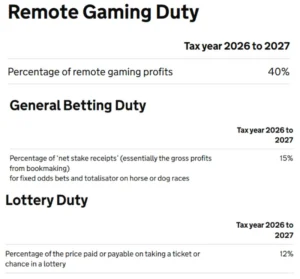
HMRC’s current 2026/27 gambling-duty rates showing the taxes paid within the gambling industry.
Can a Casino Charge You “Tax” Before Releasing Your Winnings?
Be cautious if an unfamiliar casino or gambling website tells you that a UK player must make an additional tax payment before winnings can be released.
For ordinary UK gambling winnings, there is no general player-side tax that suddenly becomes payable to a casino before a legitimate withdrawal can be made.
Real operators can still carry out:
- Identity verification
- Source-of-funds checks
- Payment-method verification
- Bonus-rule checks
- Fraud screening
- Anti-money-laundering checks
Those are not the same as asking you to transfer a supposed HMRC tax payment to unlock a prize.
Fake gambling promotions sometimes invent “tax”, “verification” or “release” charges as part of repeated-payment scams.
The warning signs described in fake casino withdrawal and tax-payment requests are therefore worth separating from genuine UK gambling tax obligations.
When Can Money From Gambling Winnings Become Taxable Later?
This is where the answer becomes more nuanced.
The original win can be tax-free, while the money it subsequently generates may fall under ordinary tax rules.
Savings Interest
Suppose you win £500,000 and put the money into an ordinary savings account.
The £500,000 win does not suddenly become taxable, but the interest earned on that £500,000 is savings income.
For 2026/27, the Personal Savings Allowance is:
| Income Tax position | Personal Savings Allowance |
| Basic-rate taxpayer | £1,000 |
| Higher-rate taxpayer | £500 |
| Additional-rate taxpayer | £0 |
There can also be a starting rate for savings of up to £5,000 for people with sufficiently low other income.
So, if a basic-rate taxpayer earns £8,000 of ordinary savings interest from a large gambling windfall, the fact that the original cash came from a tax-free jackpot does not make the interest tax-free.
What Happens If You Invest Your Gambling Winnings?
Buying shares, cryptocurrency, investment funds or property with gambling winnings creates a new transaction.
The money used to purchase the asset may have come from a tax-free gambling prize, but future profits on the investment itself can potentially be taxable.
For 2026/27:
- The individual Capital Gains Tax annual exempt amount is £3,000.
- Main individual CGT rates are 18% and 24%, depending on the person’s taxable position and nature of the gain.
Consider a simplified example:
You win £100,000 from gambling.
You invest £40,000 in shares.
Several years later, you sell those shares for £55,000.
The relevant tax question is about the £15,000 investment gain, not about retrospectively taxing the original £100,000 gambling win.
The precise taxable gain depends on acquisition costs, disposal costs, losses, exemptions and other circumstances.
Can Giving Gambling Winnings to Family Create Inheritance Tax?
Potentially.
Giving money away does not convert the original gambling prize into taxable winnings. Instead, ordinary gift and Inheritance Tax rules begin to apply.
GOV.UK confirms that:
- The annual IHT gift exemption is generally £3,000 per tax year.
- Certain other exemptions may apply.
- Gifts between qualifying spouses or civil partners are generally exempt.
- Gifts may fall outside the estate if the donor survives for seven years, subject to the detailed rules.
For example, someone winning £2 million and immediately gifting £500,000 to an adult child does not pay gambling tax on the £2 million.
But the £500,000 gift may become relevant to the person’s estate if they die within seven years.
Large wins therefore deserve estate-planning attention even though the initial jackpot is tax-free.
Does a Huge Gambling Win Change the Tax Rule?
No special UK gambling tax suddenly appears merely because the win reaches a particular figure.
The tax position on the prize itself is not generally different for:
| Amount won | Personal UK gambling tax on the original win |
| £100 | £0 |
| £1,000 | £0 |
| £10,000 | £0 |
| £100,000 | £0 |
| £1 million | £0 |
| £10 million | £0 |
Large amounts can nevertheless create practical financial issues.
A substantial winner may need to think about:
- Bank deposit protection
- Source-of-funds records
- Savings interest
- Investments
- Gifts
- Estate planning
- Financial advice
- Privacy and security
A tax-free prize should not be confused with a tax-free financial life thereafter.
Does Bonus Money or Promotional Winnings Change the Tax Position?
From the player’s personal-tax perspective, genuine gambling winnings remain subject to the normal UK gambling treatment.
However, bonus balances can have operator restrictions that determine whether the displayed amount is actually withdrawable.
Terms may cover:
- Wagering requirements
- Maximum bonus bets
- Game-contribution percentages
- Expiry dates
- Maximum cashouts
- Account verification
These conditions can determine whether a balance becomes cash available to the customer.
They do not create a separate HMRC winnings tax.
This distinction is especially relevant when considering bonus winnings and withdrawal restrictions, where promotional conditions may affect the amount that ultimately becomes withdrawable.
How Does UK Gambling Tax Compare With the United States?
The UK and US take very different approaches.
| Issue | United Kingdom | United States |
| Gambling winnings | Generally tax-free to individual player | Generally federally taxable |
| Reporting ordinary win | Usually no HMRC declaration solely for win | Gambling income generally reported |
| Operator/payer tax forms | No equivalent player winnings form in normal UK system | Form W-2G can apply |
| Gambling loss deduction | Ordinary losses do not reduce UK taxable earnings | Itemised deduction may be available subject to limits |
| 2026 loss rule | Not applicable | Deduction limited to 90% of gambling losses, capped by winnings |
The IRS states that gambling winnings are fully taxable for US federal purposes and generally must be reported, including casino, sports-betting, lottery and raffle winnings.
A significant US change applies from 2026: the gambling-loss deduction is limited to the lesser of 90% of gambling losses or gambling winnings.
That creates the possibility that a US taxpayer can have equal gross wins and losses yet still retain some taxable gambling income.
This US treatment should not be imported into a UK tax calculation.
What If a UK Gambler Wins Money Overseas?
UK rules on the nature of the gambling winnings do not necessarily prevent another country from imposing its own tax or withholding rules.
For example, an overseas casino may operate in a jurisdiction where gambling prizes are taxed at source.
Questions can then include:
- Whether local tax was withheld
- Whether a tax treaty applies
- Whether a refund can be claimed
- The person’s residence status
- The nature and location of the gambling activity
Anyone receiving a very large overseas gambling prize should check the tax rules in the country where the win arose rather than assuming the UK treatment automatically overrides foreign law.
What Should You Do After a Large Gambling Win?
Tax is only one aspect of managing a major payout.
A sensible approach is to:
- Keep evidence showing where the winnings came from.
- Check that the full balance has cleared.
- Avoid making rushed investments.
- Consider whether cash exceeds bank-protection limits.
- Review the tax treatment of future savings interest.
- Consider CGT before making major investments.
- Record substantial gifts.
- Review wills and estate planning after a life-changing win.
- Seek regulated financial or tax advice where the amount is substantial.
The priority is to separate three different questions:
Was the gambling win taxable? Usually no for a UK individual.
Can the money earn taxable income later? Yes.
Can investments, gifts or an estate create other taxes? Potentially.
That framework avoids the common mistake of assuming that because the initial winnings are tax-free, every future use of them must also be tax-free.
What Is the Bottom Line on Tax on Gambling Winnings?
For UK individuals, gambling winnings themselves are generally tax-free regardless of their size.
Ordinary casino, sports-betting, poker, bingo and lottery winnings are not treated like employment income, and gambling winnings are excluded from chargeable gains for CGT purposes.
Even a person who gambles systematically or successfully enough to make a living does not become a taxable trader merely for that reason.
The key tax issues generally begin after the win. Savings interest can become taxable, investment gains can attract CGT, commercial income related to gambling can be taxable, and large gifts can interact with Inheritance Tax rules.
Meanwhile, gambling businesses—not ordinary winners—bear gambling-specific duties such as the current 40% Remote Gaming Duty.
FAQs About Tax on Gambling Winnings
Do I have to pay tax if I win £10,000 gambling in the UK?
No. A £10,000 gambling win is generally tax-free for an individual in the UK. The size of the win does not create a separate Income Tax or Capital Gains Tax charge.
Do I need to tell HMRC about gambling winnings?
Ordinary gambling winnings do not normally need to be declared to HMRC simply because you won money. However, keeping evidence of a large win can be useful for source-of-funds checks.
Are online casino winnings taxable in the UK?
No. Genuine winnings from online casino games are generally tax-free for UK players. Gambling duties are primarily charged to licensed operators rather than individual customers.
Do professional gamblers pay Income Tax on their winnings?
Gambling regularly or successfully enough to make a living does not automatically make the winnings taxable. HMRC states that systematic or successful gambling alone does not constitute a taxable trade.
Can I deduct gambling losses from my taxable income?
Generally, no. Because ordinary gambling winnings are not taxed, gambling losses cannot normally be deducted from employment income or other taxable earnings.
Do I pay tax on National Lottery winnings?
No. National Lottery prizes are not subject to Income Tax simply because you have won them, regardless of the size of the prize.
Can gambling winnings become taxable after I receive them?
The original winnings may remain tax-free, but income or gains generated from the money later can be taxable. Examples include savings interest, investment profits and rental income.
Do I pay tax if I invest my gambling winnings?
You do not pay tax simply for investing tax-free winnings. However, subsequent investment profits may be subject to Capital Gains Tax, Income Tax or dividend tax, depending on the investment.
Can I give gambling winnings to my family tax-free?
You can give money to family members, but normal Inheritance Tax gift rules can apply. Large gifts may remain relevant to your estate if you die within seven years.
Is gambling tax different in the UK and the US?
Yes. UK gambling winnings are generally tax-free for individual players, while gambling winnings in the United States are generally treated as taxable income and must normally be reported to the IRS.